

Your guide to the major forces shaping the future of FoodTech
FoodTech is entering one of its most transformative years yet. To help corporates, innovators, and investors navigate what’s coming, we engaged our global network of 2,500+ FoodTech Experts, conducted interviews, and analysed market signals across the U.S., Europe, and key global markets.
The result is the 2026 FoodTech Trends Report – a forward-looking, expert-driven assessment of the eight trends that will define FoodTech in the year ahead.
Get a strategic, data-backed view of what will matter most in 2026 – what will scale fast, where companies should invest, and which technologies, consumer behaviors, and supply chain shifts are already reshaping the landscape.
The report includes:
FoodTech Experts (FTE) is Bright Green Partners’ expert sourcing service, giving you fast, flexible access to 2,500+ vetted professionals across 60+ countries. About us in brief – From startup founders to ex-corporate leaders, our experts bring deep experience in fermentation, extrusion, biotechnology, upcycling, and more. Whether you’re shaping strategy, validating tech, or scaling operations – FTE helps you make smarter decisions, faster. Get curated matches in as little as 48 hours, engage on project or fractional terms, and manage everything through a single contract. Work remote or on-site across time zones with strict NDAs and clear deliverables. Typical outcomes include TEA models, pilot plans, vendor shortlists, regulatory and labeling outlines, and commercialization roadmaps that keep budgets and timelines on track.
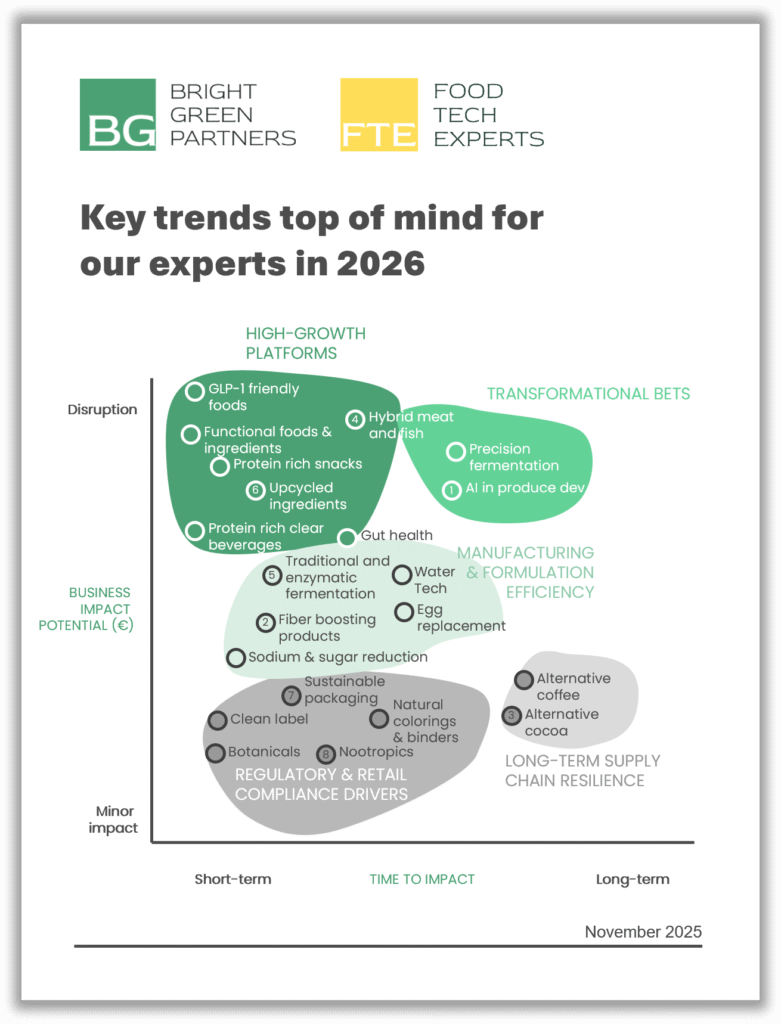
Our 2026 FoodTech Trends Report identifies the most influential trends that our global expert network expects to shape the industry in the year ahead. These trends sit across a spectrum of time-to-impact and business impact potential, revealing where companies can expect fast-moving commercial opportunities versus longer-term transformational bets.
The analysis highlights several high-growth platforms already gaining strong momentum — including GLP-1 friendly foods, functional ingredients, hybrid meat and fish, and upcycled ingredients. At the same time, technologies such as AI in product development and precision fermentation are emerging as powerful drivers of long-term disruption.
The report also maps trends tied to manufacturing efficiency, regulatory and retail compliance, and supply-chain resilience, such as sustainable packaging, sodium and sugar reduction, natural colorings, and alternative cocoa and coffee. Together, these insights offer a clear view of where innovation, investment, and competitive advantage are likely to converge in 2026.
"*" indicates required fields
"*" indicates required fields